Physical Address
304 North Cardinal St.
Dorchester Center, MA 02124
Physical Address
304 North Cardinal St.
Dorchester Center, MA 02124

Teachers employed by the Teachers Service Commission (TSC) are entitled to different types of leave depending on their circumstances.
Each type of leave has its own rules on how many days a teacher can take, whether the leave is paid, who approves it, when it should be taken and what supporting documents may be required.
Some TSC leave entitlements have also changed over time. For example, maternity leave increased from 90 to 120 calendar days, while paternity leave increased from 14 to 21 calendar days under the 2021 CBA arrangements.
TSC has also moved leave administration to its online system, allowing teachers to submit leave applications through HRMIS.
This guide explains the different types of TSC leave available to teachers in Kenya, their entitlements, important requirements and how to apply.
Important: Where an older provision has been changed by a later TSC circular or CBA provision, the later provision is used in this guide.
| Type of Leave | Entitlement | Pay |
|---|---|---|
| Annual leave | 30 calendar days per calendar year worked | Full pay |
| Maternity leave | 120 calendar days | Full pay |
| Paternity leave | 21 calendar days | Full pay |
| Pre-adoptive leave | 45 calendar days | Full pay |
| Compassionate leave | Up to 15 calendar days | According to applicable provision |
| Sick leave – general provision | 3 months + further 3 months | Full pay, then half pay |
| Sick leave – contract of up to one year | 1 month + further 1 month | Full pay, then half pay |
| Research/project leave | Up to 3 months | With pay |
| Special leave | Up to 3 months | With pay |
| Sports special leave | Necessary period of training and participation | Full pay |
| Exceptional-hardship leave | Not more than 3 months | Without pay |
| Diplomatic-spouse leave | Period of spouse’s assignment outside Kenya | Without pay |
| Compulsory leave | Not more than 30 days | Full pay |
The exact conditions for some categories are more important than the number of days alone. Teachers should therefore check the requirements for the specific type of leave before applying.
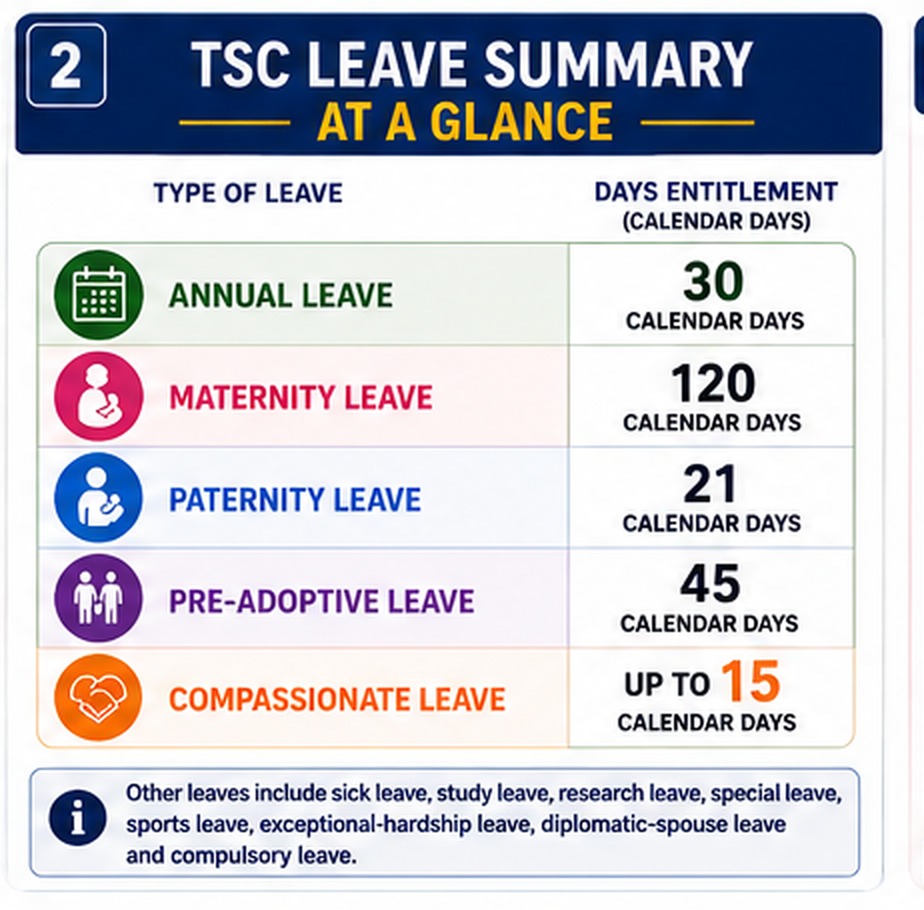
TSC leave entitlements at a glance, including annual, maternity, paternity, pre-adoptive and compassionate leave.
A teacher is entitled to 30 calendar days of annual leave with full pay for each calendar year worked under the TSC Code of Regulations for Teachers.
Annual leave is to be taken during school holidays. The Code also provides that annual leave should not be accumulated for carrying forward from one year to another.
30 calendar days.
The entitlement is based on each calendar year worked.
Annual leave should be taken during school holidays.
However, teachers should not assume that a school holiday automatically constitutes an approved annual-leave period. The leave itself is subject to the applicable application and approval procedure.
Circular No. 9/2018 provides that annual leave should be approved by the Sub-County Director.
Yes.
The CBA Circular No. 12/2024 lists an annual leave allowance payable once a year and confirms that the allowance remained unchanged under that circular.
The amount depends on the teacher’s grade.
Examples include:
Important: Annual leave allowance and annual leave days are two different things. The allowance is a payment, while the leave entitlement is the 30 calendar days.
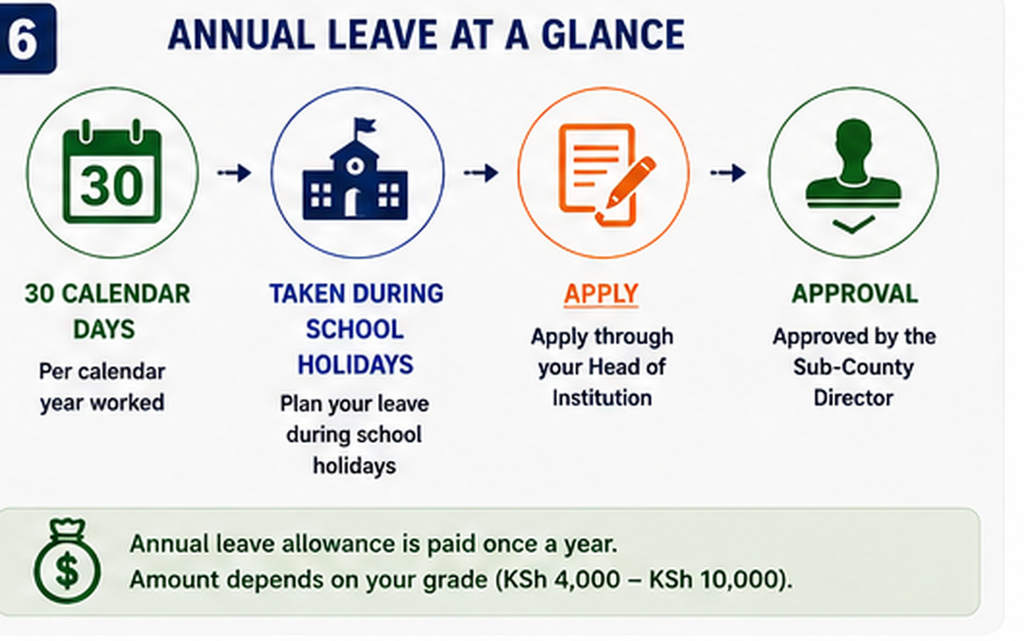
TSC annual leave is 30 calendar days per calendar year worked and is taken during school holidays.
The current maternity entitlement established by the later TSC provision is:
This was an increase from the previous 90-calendar-day entitlement.
The 120-calendar-day entitlement took effect from 1 July 2021.
Maternity leave is granted with effect from the date of delivery.
No.
A female teacher does not forfeit annual leave because she has taken maternity leave.
The entitlement is:
120 calendar days with full pay.
Teachers should use the applicable HRMIS leave application process and enter the dates corresponding to the maternity leave being requested.
TSC paternity leave is:
The 21-day entitlement replaced the previous 14-calendar-day entitlement under the 2021 CBA arrangements.
The 21-calendar-day entitlement took effect from 1 July 2021.
Paternity leave is to be taken within the duration of the spouse’s maternity leave.
The 2015 Code provides that paternity leave may be granted once in a calendar year.
The prescribed paternity-leave form in the Code requires a certified copy of the Birth Notification to accompany the application.
Since TSC subsequently moved leave applications to the online system, teachers should follow the current HRMIS application process rather than assuming that the old paper form is the current submission method.
A teacher who qualifies for pre-adoptive leave is entitled to:
The leave starts from the date of adoption.
Pre-adoptive leave is therefore different from both maternity and paternity leave.
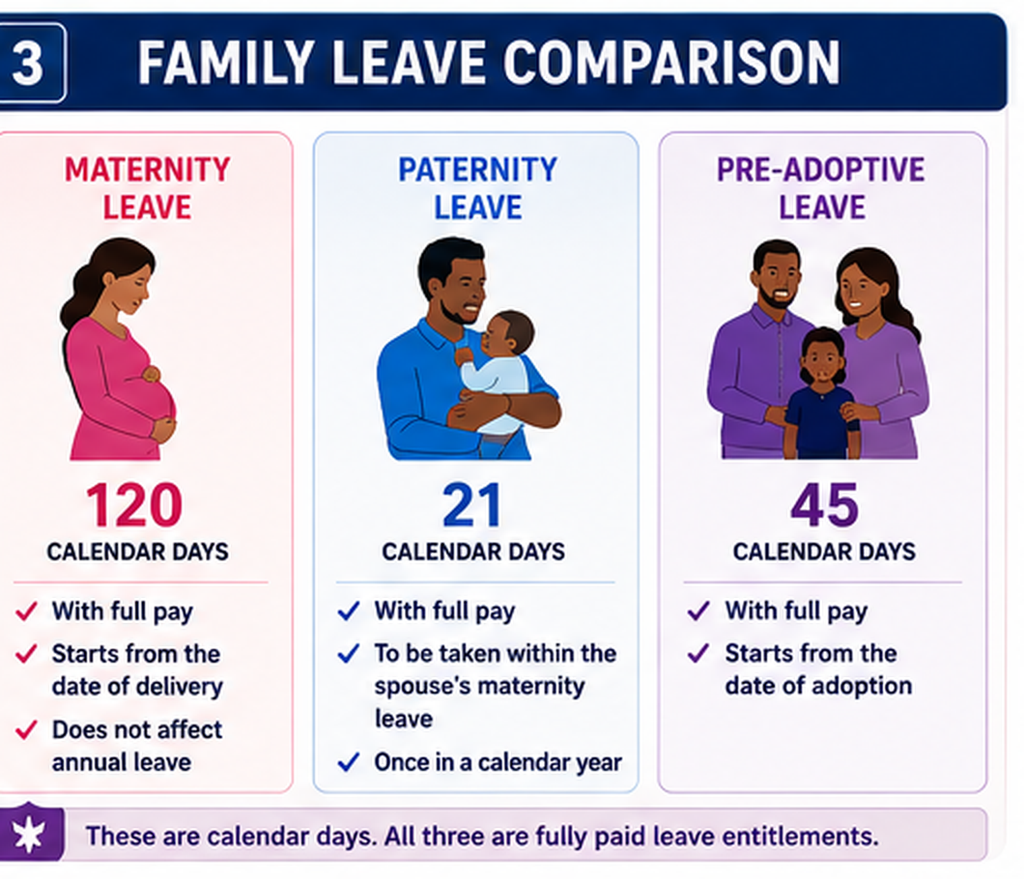
Comparison of TSC maternity, paternity and pre-adoptive leave entitlements.
TSC sick leave has different provisions depending on the teacher’s terms of service.
The Code provides for:
This means that the initial sick-leave period can extend to six months within a continuous 12-month period, subject to the conditions in the Code.
For teachers serving under contracts of not more than one year, the provision is:
The Code provides different timelines depending on treatment.
For outpatient treatment, the application should be forwarded within 48 hours.
For inpatient treatment, the application should be forwarded within 7 days.
Where a teacher is unable to make the application personally because of the nature or extent of the sickness, the Head of Institution is required to inform the Sub-County Director in writing within 14 days of receiving information about the sickness.
Where a teacher remains continuously on sick leave for more than one year, the Code provides for the Commission to recommend to the Director of Medical Services that a Medical Board be convened to determine whether the teacher is fit to continue teaching.
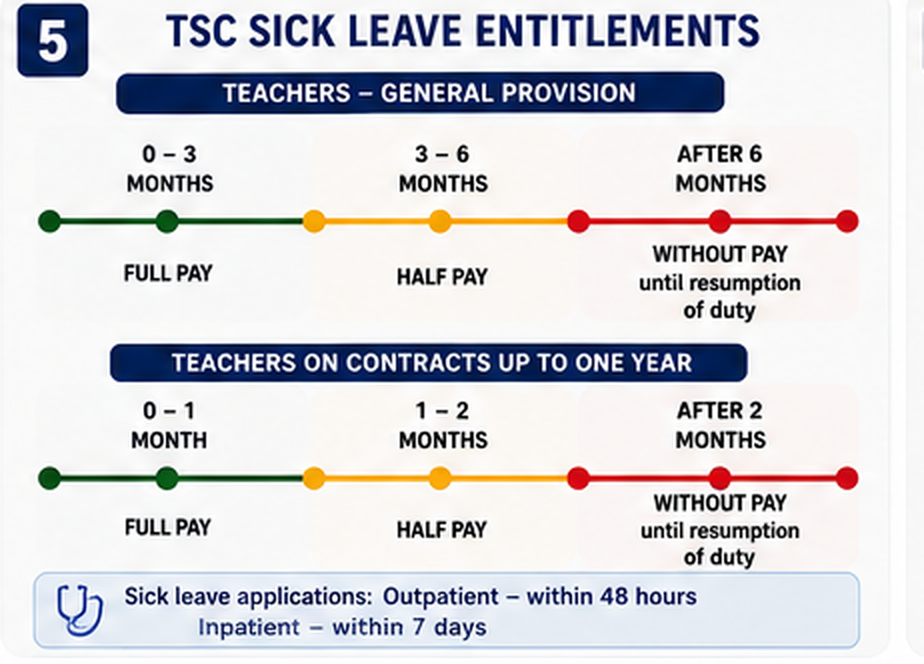
TSC sick-leave pay periods for teachers under the general provision and teachers on contracts of up to one year.
A teacher may be granted up to 15 calendar days of compassionate leave.
The circumstances covered include matters such as:
Compassionate leave should not be used for leisure or for attending seminars, workshops or conferences.
Depending on the circumstances and application route, approval may be by the Head of Institution or Sub-County Director.
A teacher applies through the applicable procedure.
Where the applicant is the Head of Institution, the application is made to the Sub-County Director.
Study leave is different from annual or maternity leave because its approval depends on the nature of the course or programme and the applicable study-leave requirements.
A teacher seeking study leave applies through the Head of Institution using the applicable application process.
The teacher should not proceed on study leave merely because they have been admitted to a course.
The teacher must first obtain:
Proceeding without the required approval and release can have serious disciplinary consequences.
The prescribed Study Leave Form states that teachers applying for study leave with or without pay must have served in the teaching profession for at least five years.
The application should reach TSC Headquarters at least 30 days before commencement of studies and should include the admission letter from the university or college.
The Code provides for study leave with pay for qualifying courses, study or training considered by the Commission to be of national interest and relevant to the teaching service, subject to the applicable study-leave policy.
A teacher studying through a part-time or holiday-based programme may, upon application, be granted research or project leave.
The entitlement is:
The Code specifies that:
TSC may grant special leave with pay to a teacher who has been selected and appointed to attend a:
The maximum period specified in Regulation 132 is:
The event or activity must, in the Commission’s opinion, be of national or public interest or relevant to education and the teaching service.
A teacher selected to represent Kenya in a national, regional or international sporting event may be granted special leave with full pay.
The leave covers the necessary period of training and subsequent participation in the sporting activity.
The Code does not give a fixed number of days for this category.
The period therefore depends on the training and participation requirements.
Exceptional-hardship leave should not be confused with the ordinary 15-day compassionate leave.
Where a teacher has a proven case of exceptional hardship, the Commission may, at its discretion, grant leave of absence or compassionate leave without pay.
The provision states that:
A teacher whose spouse is in diplomatic service and has been assigned to duty outside Kenya may apply for unpaid leave.
The application is made in writing to TSC and should be supported by the relevant documentation.
The Code also provides for the teacher to apply for posting one month before the end of the spouse’s assignment.
Compulsory leave is not ordinary leave requested by a teacher.
Under Regulation 136, the Secretary may personally send a teacher on compulsory leave with full pay to allow investigations into allegations against the teacher.
The maximum period specified is:
The Code requires the reasons for compulsory leave to be stated in writing.
The Board of Management does not have the power to place a teacher on compulsory leave under this particular provision.
A teacher who wants to spend leave outside Kenya needs more than ordinary leave approval.
Circular No. 9/2018 states that a teacher intending to spend leave outside Kenya must obtain clearance from TSC Headquarters under Regulation 137.
The request should be accompanied by a copy of the approved leave.
Therefore:
Approved leave does not, by itself, constitute permission to spend that leave outside Kenya.
TSC introduced online leave processing through the HRMIS Leave Module.
The Leave Online Module was effected from 1 November 2021, while Circular No. 17/2021 provided for online leave applications instead of manual applications.
The HRMIS Teachers Leave Module Guide provides the procedure for teachers.
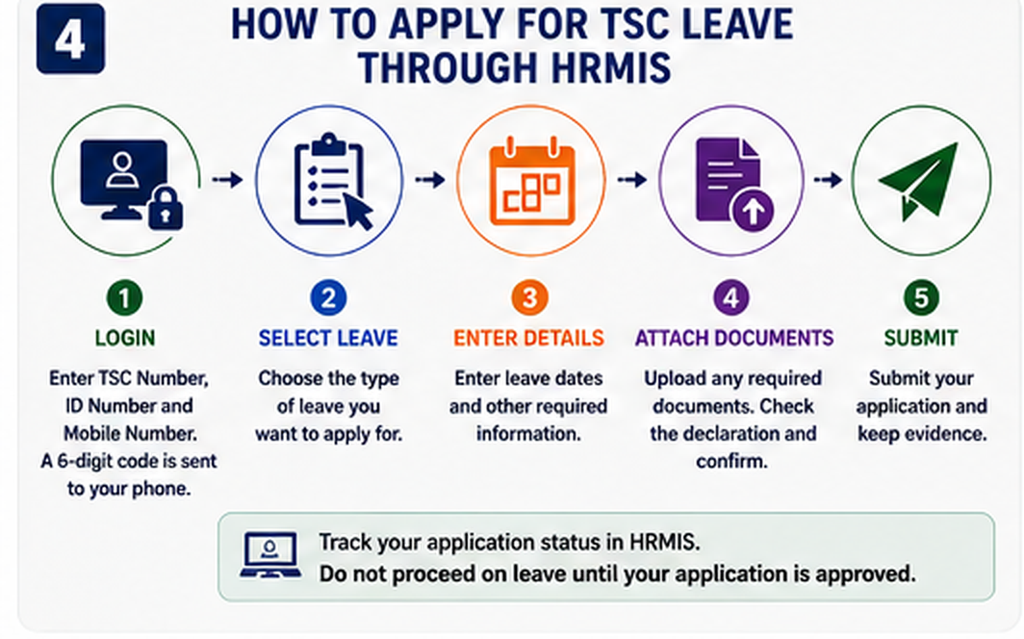
The basic HRMIS process for applying for TSC leave: log in, select leave, enter details, attach documents and submit.
The HRMIS Teachers Leave Module requires the teacher to enter:
A six-digit authorization code is then sent to the teacher’s mobile phone for authentication.
After logging in, the system identifies the teacher’s category.
The teacher then selects the option to submit a new leave application and chooses the applicable leave type.
The teacher enters the required leave information, including the relevant leave dates and other required details.
The dates entered should correspond to the leave being requested.
Where supporting documents are required, the teacher uses the attachment option to select and upload the relevant document.
The teacher then checks the declaration and confirms the attachment.
The teacher completes the required declaration and submits the application through the system.
The teacher should keep evidence of the application and monitor its status.
The HRMIS Teachers Leave Module Guide documents the process and interface used when the guide was produced.
Individual screen layouts or button positions may change over time.
Teachers should therefore follow the current screens displayed in HRMIS while using the documented process as a guide.
The HRMIS guide also provides a separate process for Heads of Institutions.
The Head of Institution accesses the relevant portal, logs in using the required credentials and authorization process, and views teachers’ leave applications.
The guide shows the Head of Institution using the View/Edit function to review the application, enter remarks and process the request.
The HOI can also view supporting documents attached to the application.
No.
A teacher should distinguish between:
Submitting an application does not automatically mean that the teacher should proceed on leave.
For example, study leave requires the necessary TSC approval and written release by the Head of Institution before the teacher proceeds.
Teachers should therefore wait for the required approval before proceeding on leave.
A teacher is expected to resume duty on the approved return date.
Where additional time is required, the teacher should use the applicable procedure to request an extension rather than simply remaining absent after the approved leave period.
Teachers should comply with the approved leave dates and applicable reporting requirements because unauthorized absence can have disciplinary consequences.
| Leave Type | Number of Days |
|---|---|
| Annual leave | 30 calendar days |
| Maternity leave | 120 calendar days |
| Paternity leave | 21 calendar days |
| Pre-adoptive leave | 45 calendar days |
| Compassionate leave | Up to 15 calendar days |
| Compulsory leave | Not more than 30 days |
| Research/project leave | Up to 3 months |
| Special leave | Up to 3 months |
| General sick leave | 3 months + further 3 months |
| Contract sick leave, up to one year | 1 month + further 1 month |
| Exceptional-hardship leave | Not more than 3 months |
The number of days should always be read together with the conditions attached to the particular leave category.

Other TSC leave categories include study, research/project, special, sports, compassionate, exceptional-hardship, diplomatic-spouse and compulsory leave.
TSC annual leave is 30 calendar days with full pay for each calendar year worked.
TSC maternity leave is 120 calendar days with full pay.
TSC paternity leave is 21 calendar days with full pay.
The leave is to be taken within the duration of the spouse’s maternity leave.
Pre-adoptive leave is 45 calendar days with full pay, starting from the date of adoption.
A teacher may be granted up to 15 calendar days of compassionate leave.
The 2015 Code states that annual leave shall not be accumulated for carrying forward from one year to another.
Not automatically.
A teacher intending to spend leave outside Kenya must obtain the required TSC Headquarters clearance in addition to the underlying leave approval.
No.
An admission letter is part of the study-leave application requirements, but the teacher must obtain the required TSC approval and written release before proceeding on study leave.
No.
Different leave categories have different pay arrangements.
For example, maternity and paternity leave are fully paid under the later provision, while exceptional-hardship leave and diplomatic-spouse leave are unpaid under the cited Code provisions.
No.
The applicable maternity provision specifically protects the teacher from forfeiting annual leave because of maternity leave.
TSC teachers have several different leave entitlements, but the rules are not the same for every type of leave.
The main entitlements covered in this guide are:
The most important thing for a teacher is to identify the correct leave category, check its specific requirements, submit the application through the applicable TSC process, provide the required supporting documents and obtain the required approval before proceeding on leave.
Teachers should also ensure that they resume duty on the approved return date unless an extension has been formally granted.
This guide is based on the TSC documents reviewed for this subject, including:
The 2026 amendment reviewed for this article concerns Regulation 20 on conditions for registration of teachers and does not amend the leave provisions covered in this article.
The 2024 CBA Circular also does not introduce a new number of annual-leave days. It addresses implementation of the reviewed remuneration cycle and confirms that the annual leave allowance remained unchanged.
If you are looking for information about a specific type of TSC leave, see our detailed guides: