Physical Address
304 North Cardinal St.
Dorchester Center, MA 02124
Physical Address
304 North Cardinal St.
Dorchester Center, MA 02124


The Teachers Service Commission (TSC) is the constitutional commission responsible for managing Kenya’s teaching service. Its mandate goes far beyond employing teachers.
TSC’s responsibilities include teacher registration, recruitment and employment, assignment, promotion, transfer, disciplinary control and termination. The Commission also has statutory responsibilities covering teaching standards, payroll management, career progression, professional development, and monitoring teachers’ conduct and performance.
Understanding these functions helps teachers know what falls within TSC’s mandate and, equally importantly, understand the difference between having a legal function or power and how that power must be exercised under the law.
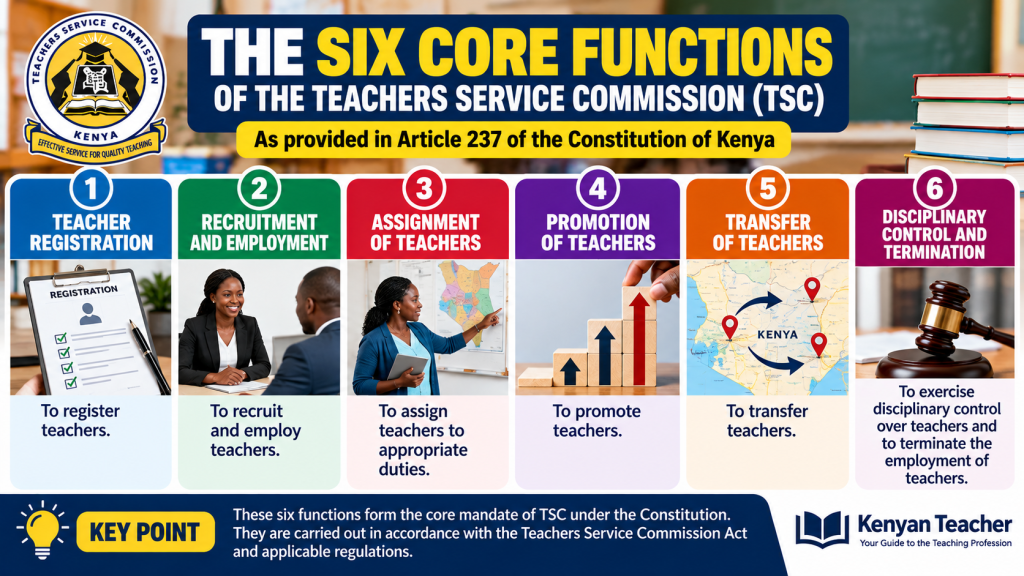
Article 237 of the Constitution gives the Teachers Service Commission the following core functions:
Register trained teachers.
Recruit and employ registered teachers.
Assign teachers employed by the Commission to public schools or institutions.
Promote and transfer teachers.
Exercise disciplinary control over teachers.
Terminate the employment of teachers.
Teacher registration is a constitutional and statutory responsibility of TSC.
Section 23 of the TSC Act provides that the Commission is responsible for registering trained teachers in the teaching service. TSC’s online services provide a platform through which applicants can apply for registration.
Registration is therefore part of the legal framework governing entry into Kenya’s teaching service.
Recruitment and employment of registered teachers is another constitutional function of TSC.
The Commission advertises teaching vacancies and provides online systems through which applicants can apply for advertised positions.
This means recruitment into TSC teaching positions falls within the Commission’s constitutional mandate.
TSC has the constitutional function of assigning teachers employed by the Commission to public schools or institutions.
The Code of Regulations contains provisions dealing with posting and assignment.
This is important because employment by TSC does not mean that a teacher necessarily has a permanent right to remain at one particular school.
Promotion of teachers is expressly included among TSC’s constitutional functions.
TSC conducts promotion exercises and publishes advertisements setting out vacancies and requirements for particular grades.
However, TSC having the function of promoting teachers does not mean that every teacher is automatically entitled to promotion.
Specific requirements, procedures, vacancies and applicable conditions determine eligibility for a particular promotion exercise.
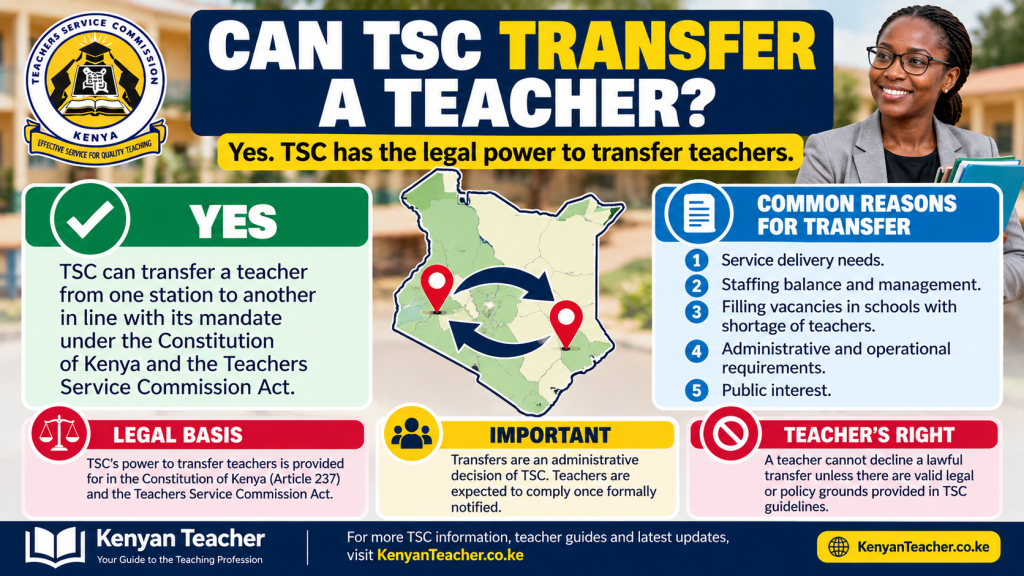
Transfer of teachers is also a constitutional function of TSC.
The Code of Regulations provides circumstances in which the Commission may transfer a teacher. These include considerations such as equitable distribution and utilization of teachers, availability of vacancies, the need for replacement, staffing requirements and other circumstances provided for under the applicable framework.
Teachers can also apply for transfer.
So, while TSC has the constitutional function of transferring teachers, individual transfers are still governed by the applicable regulations and procedures.
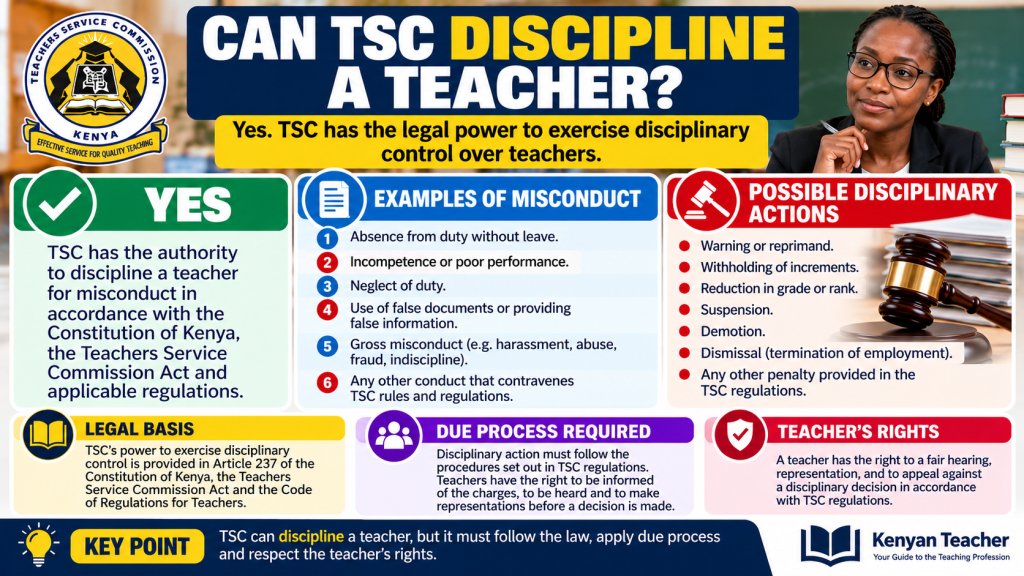
The Constitution gives TSC disciplinary control over teachers.
The TSC Act provides the statutory framework governing disciplinary matters.
Having disciplinary authority does not mean that any disciplinary outcome can simply be imposed without following the applicable legal and procedural framework.
The particular allegation, evidence, process and applicable provisions matter in an individual case.
Termination of teachers’ employment is expressly included among TSC’s constitutional functions.
The TSC Act also contains provisions dealing with disciplinary action and termination.
TSC therefore has a legal mandate to terminate the employment of teachers. The existence of that function should not be confused with an unrestricted power to terminate employment without regard to applicable law and procedure.

The TSC Act gives the Commission additional statutory functions beyond those listed in Article 237.
One of these is formulating policies to achieve its mandate.
This means TSC’s work includes developing policies that support the management and regulation of the teaching service.
Section 11 of the TSC Act requires the Commission to provide strategic direction, leadership and oversight to the Secretariat.
This is an institutional function concerned with how the Commission’s Secretariat operates and implements the Commission’s mandate.
TSC is responsible for ensuring that teachers comply with teaching standards prescribed by the Commission under the law.
This connects TSC’s teacher-management responsibilities with professional standards and the quality of the teaching service.
The TSC Act expressly gives the Commission responsibility for managing the payroll of teachers in its employment.
This places teacher payroll management within TSC’s statutory mandate.
It should not, however, be interpreted to mean that every question concerning public-sector remuneration falls exclusively within TSC’s mandate. Different government institutions have different legal responsibilities.
The TSC Act requires the Commission to facilitate career progression and professional development for teachers in the teaching service, including the appointment of head teachers and principals.
Professional development is therefore expressly part of TSC’s statutory mandate.
The Commission is also responsible for monitoring the conduct and performance of teachers in the teaching service.
This function connects with other aspects of TSC’s mandate, including teaching standards, professional development and disciplinary control.
TSC’s role therefore continues after a teacher has been recruited.
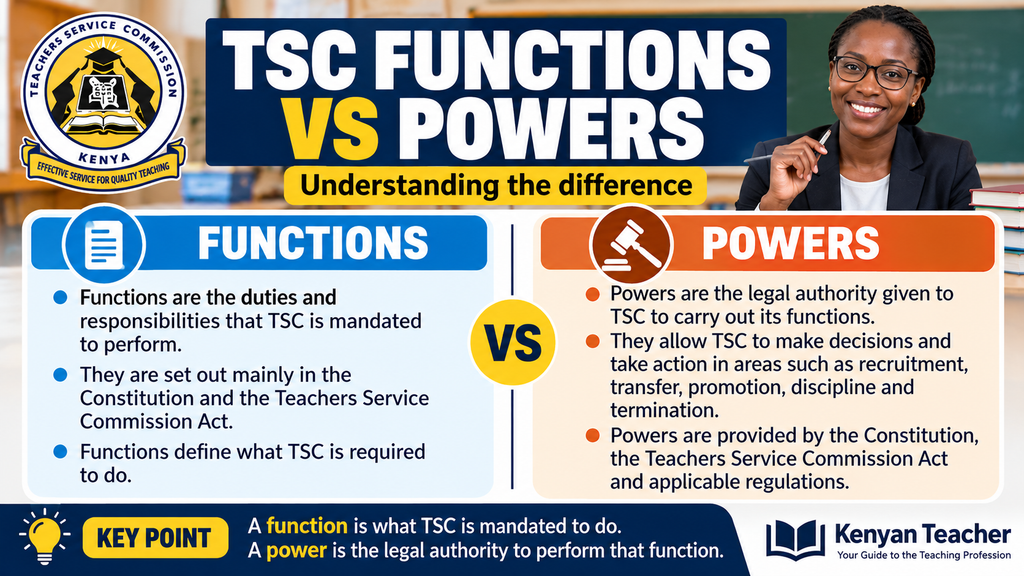
A function describes what TSC is mandated to do.
A power refers to the legal authority and mechanisms available to the Commission to perform those functions.
Section 12 of the TSC Act provides that the Commission has the powers necessary for executing its functions under the Constitution and the Act.
The Act also provides specific mechanisms through which the Commission can obtain information and statements and require attendance before the Commission or one of its committees.
Yes. The TSC Act provides for delegation of the Commission’s functions, subject to the Act.
This helps explain why a teacher may deal with an authorized TSC officer, committee or office rather than directly with the full Commission.
No.
TSC is a constitutional commission, but its functions and powers operate within the Constitution and legislation governing the Commission.
This distinction is particularly important when dealing with transfers, disciplinary action, termination, promotion or other employment matters.
There are two separate questions: Does TSC have the function or power to deal with this matter? And was that function or power exercised according to the applicable law and procedure?
Those two questions should not automatically be treated as the same question.
Functions describe what TSC is mandated to do. Powers describe the legal authority and mechanisms available to TSC to carry out those responsibilities.
Function = what TSC is responsible for.
Power = the legal authority to carry out the function.
Which laws establish TSC’s functions and powers?
The main legal framework includes the Constitution of Kenya, Article 237; the Teachers Service Commission Act; and the Code of Regulations for Teachers.
The Constitution establishes the Teachers Service Commission and sets out its principal constitutional functions.
The TSC Act provides additional functions, powers and procedures governing the Commission.
The Code of Regulations for Teachers provides detailed regulations governing aspects of teacher management.
Understanding TSC’s mandate helps teachers identify the Commission’s responsibility in matters such as registration, recruitment, deployment and assignment, promotion, transfer, professional development, performance, discipline, termination and payroll.
It also helps a teacher distinguish between TSC’s general legal mandate and the specific legal procedure applicable to an individual case.

The Constitution gives TSC responsibility for registering trained teachers, recruiting and employing registered teachers, assigning teachers, promoting and transferring teachers, exercising disciplinary control and terminating employment. The TSC Act adds further statutory functions.
Yes. Transfer is one of TSC’s constitutional functions, while the Code of Regulations provides additional rules concerning teacher transfers.
Yes. TSC has constitutional disciplinary control over teachers, subject to the applicable legal and procedural framework.
Yes. Termination of teachers’ employment is expressly included among TSC’s constitutional functions.
Yes. Registration of trained teachers is a constitutional and statutory responsibility of TSC.
Yes. The TSC Act specifically identifies career progression and professional development as functions of the Commission.
Functions describe the responsibilities assigned to TSC, while powers are the legal authority and mechanisms available to the Commission for carrying out those responsibilities.
The Teachers Service Commission has a broad constitutional and statutory mandate over Kenya’s teaching service.
Its constitutional functions cover registration, recruitment and employment, assignment, promotion, transfer, disciplinary control and termination.
The TSC Act adds responsibilities involving policy formulation, teaching standards, payroll management, career progression, professional development, and monitoring teachers’ conduct and performance.
Knowing that TSC has a particular function or power is not the same as determining whether it exercised that power lawfully in a particular case.
For an individual matter, the relevant provisions of the Constitution, TSC Act, regulations, policies and applicable procedures must be examined.